SSD (solid-state drive). The device that replaced hard drives. It is a set of chips (Flash memory and controllers) on a printed circuit board. Unlike a hard drive, it does not contain electric motors and generally works faster. But these devices have their drawbacks, which are partially compensated by the controller (monitoring the wear of memory cells, for example). Therefore, when choosing the main or additional storage of information, in some situations it is still better to use a hard disk, in others – an SSD. 😉
SSD does not require defragmentation. In addition, defragmentation can damage it.
There are several varieties of connecting an SSD to a computer and several options for the appearance of the device. For example, designed to be installed directly on the motherboard M2, variants with a SATA bus in a case resembling a 2.5-inch hard drive or an external device connected via a USB interface.
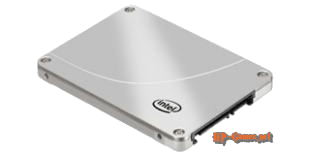
Already an old Intel solid-state drive (SSD)